Learning how to trade weather markets has less to do with forecasting skill than most traders expect. The consistent winners know exactly what each contract settles on, read the same free forecast data the market prices from, and skip the trades fees have already killed. Daily contracts are where most of the weather-market action is, and because they repeat every day, the skill builds quickly.
What daily weather markets are and how they work.
Daily weather markets are prediction markets on one day's weather in one city. Three contract types repeat every day: the day's high temperature, the day's low temperature, and whether measured rain at the reporting station exceeded zero inches. High and low markets run in the most cities and carry most of the trading; daily rain markets cover a smaller set of cities on the same cycle.
If you already trade prediction markets, the contracts work the same way: yes/no positions priced in cents. What changes is the cycle. A fresh set of contracts opens for every city each day, a single weather station's instruments decide the outcome, and you know whether you were right within a day.
How the temperature brackets work.
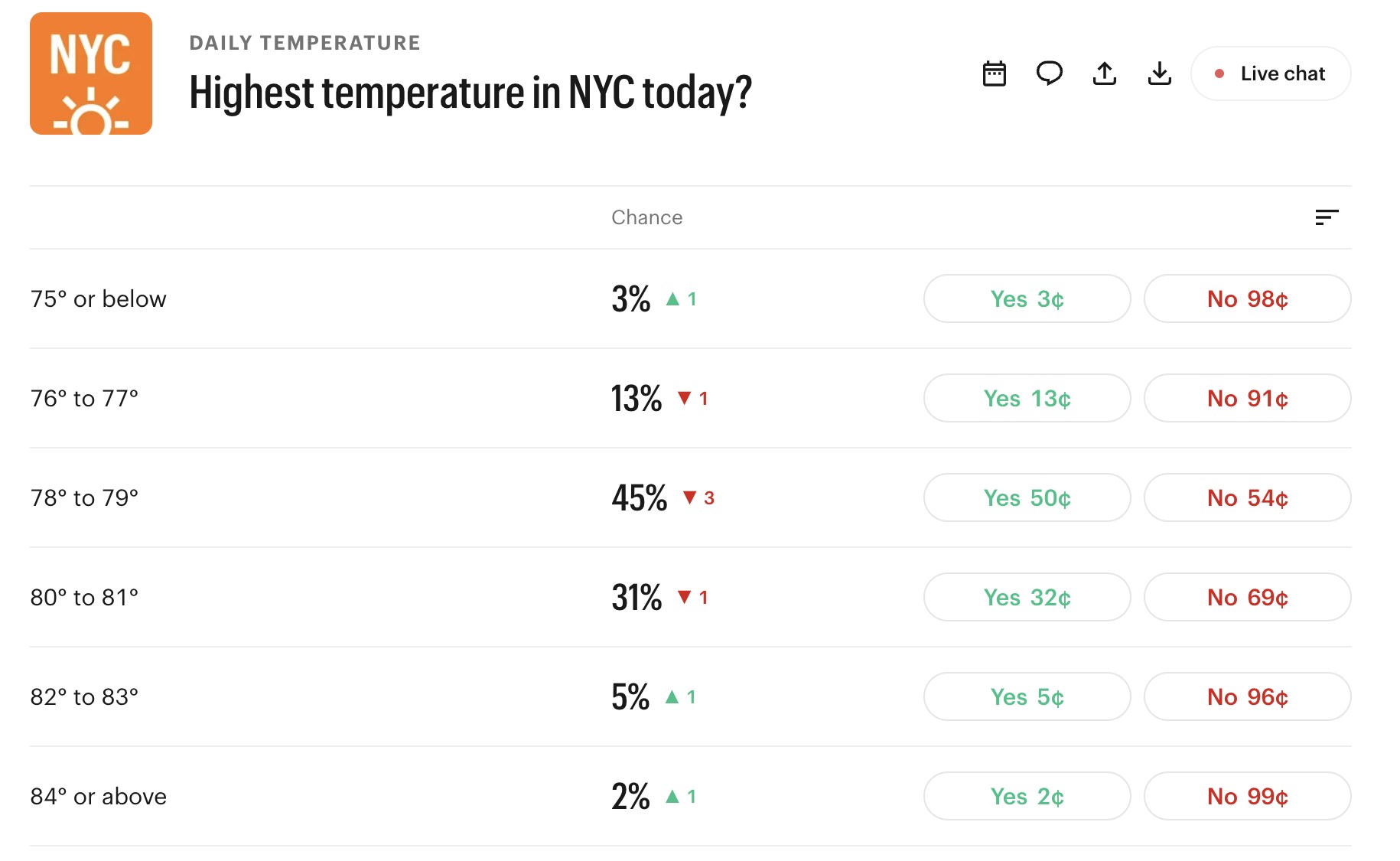
A day's market for one city is a small set of yes/no contracts, each covering a range of possible high temperatures, and a typical day has six. Take a New York day where the six brackets run 76 degrees or below, 77 to 78, 79 to 80, 81 to 82, 83 to 84, and 85 or above. Each of the four middle brackets covers exactly two degrees.
The 77-to-78 contract pays out if the day's high lands on 77 or on 78, and the same pattern holds through 83-to-84. The two end brackets are open ended: 76-or-below pays on any high at or under 76, and 85-or-above pays on any high at or over 85.
Each contract prices between 1 cent and 99 cents, and the price reads as an implied probability, so a bracket at 30 cents implies a 30 percent chance that the day's high lands in that range. Exactly one contract pays out each day, which means prices across the six should add up to roughly a dollar; the excess above a dollar is the spread you pay to enter.
Where daily weather markets trade.
Kalshi lists daily high, daily low, and daily rain markets across dozens of US cities, with new cities added as its climate and weather category grows. Kalshi weather markets trade as one series per city (KXHIGHNY is the New York daily high series).
A daily rain market asks a single yes-or-no question for a named city: did measured precipitation at the reporting station exceed zero inches that day. Unlike a temperature market, there are no brackets to choose between, so you are buying one side of one question. Settlement source also differs by series: Kalshi's multi-city daily rain series settles to The Weather Company,1Kalshi, "Weather Markets," help.kalshi.com, July 2026 while its single-city rain series settle to the National Weather Service report that also settles its temperature markets.
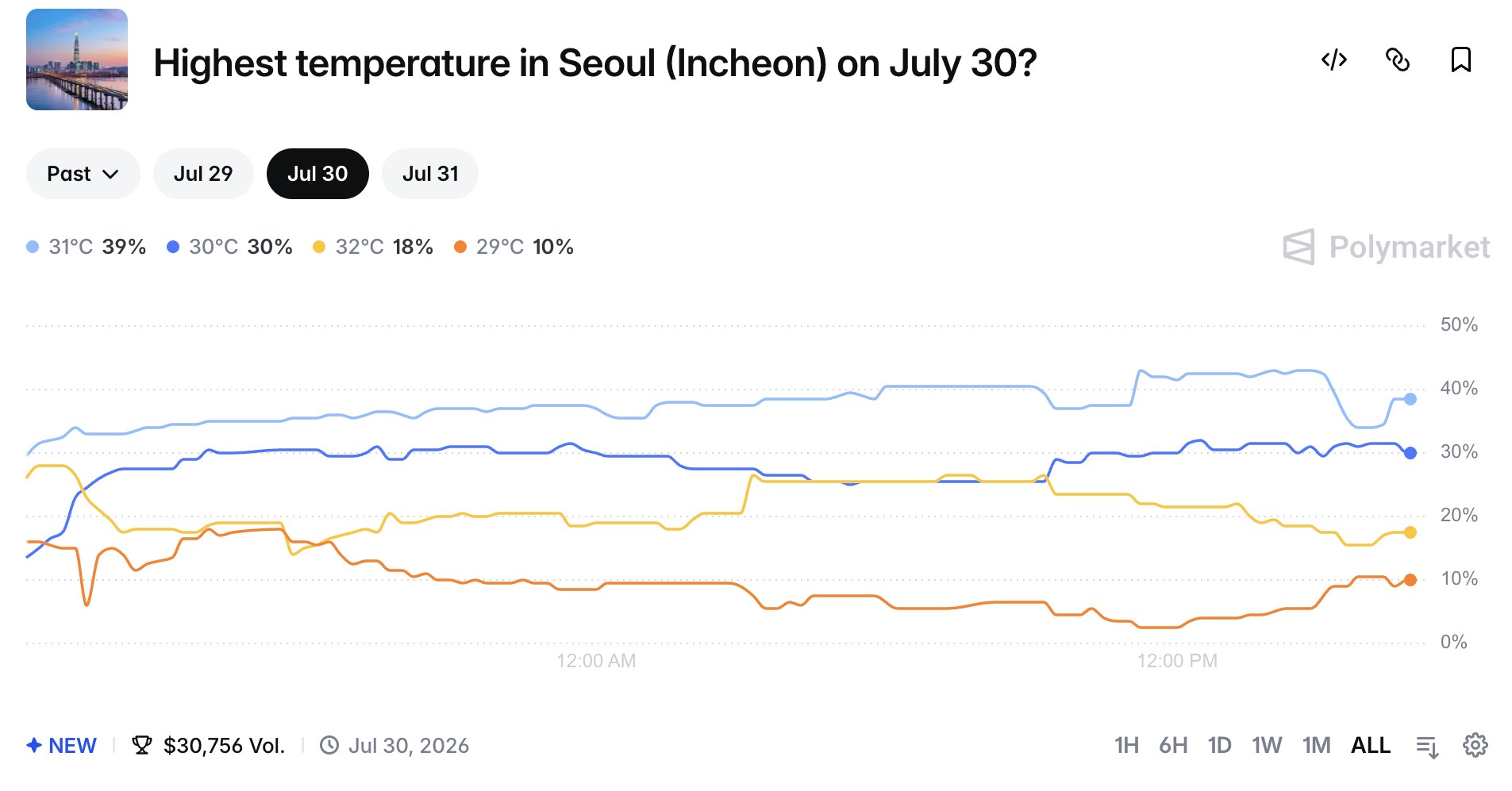
Polymarket runs two separate exchanges, and the difference matters for US readers. Its international exchange lists hundreds of live daily weather markets across cities worldwide, with Seoul, Shanghai, and Hong Kong among the most active, but it is unavailable to US persons; the United States sits on Polymarket's own list of blocked countries.2Polymarket, "Geographic Restrictions," help.polymarket.com, July 2026 Its US exchange, Polymarket US, is CFTC-regulated and lists daily temperature markets for a smaller set of American cities, settling on the same National Weather Service reports Kalshi uses.3Polymarket US, "Weather FAQs," docs.polymarket.us, July 2026
US traders can also reach daily weather contracts through Robinhood, which lists event contracts from Kalshi and ForecastEx,4Robinhood, "Trading Event Contracts," robinhood.com, July 2026 or through Interactive Brokers, which operates the ForecastEx exchange. Polymarket's daily markets use the same bracket format as Kalshi's, so the mechanics in the sections that follow apply on either platform.
Lifecycle of a daily weather market.
Every daily weather market follows the same arc. It opens the morning before the day it covers, when nothing has been observed yet, so prices move on forecasts alone. The bracket the forecast favors trades at the highest price, and brackets further from the forecast trade cheaper.
Once the day starts, the station reports the actual temperature every hour, and prices move on what the station has recorded rather than on what forecasts predict. A day's high can only rise, so brackets below the current high die off one by one as the afternoon warms. If the station's highest reading so far is 83 degrees, every contract that needed the high to stop at 82 or below is dead, whatever the forecast said at breakfast.
By late afternoon the day's high is often already recorded, and the leading bracket trades in the 90s until the market closes and settles the next morning. That day's contracts expire, a new set opens for every city, and the cycle restarts. Each cycle turns on a single number: the official high, measured by one station and written into one report.
How one small business uses daily weather markets.
These markets are not only for speculators. 28wishes, an independent ice cream shop in downtown Los Angeles, loses roughly 20 percent of its business when the temperature drops below 70 degrees, so its owners buy cold-weather contracts on Kalshi.5Faran Krentcil, "Savvy ice cream shop owner makes 43% of monthly rent betting on weather," nypost.com, July 2026 When a cold snap keeps customers home, the contracts pay out on the same days the shop loses sales.
The owners put about 20 dollars a day into daily climate markets and have cleared as much as 1,500 dollars in a month, roughly 40 percent of the shop's rent. They build their positions from public weather forecasts and climate coverage, the same information any trader can read.
That is the other use of a daily weather market: pricing a real-world risk you already carry. A business that loses money on cold or rainy days can buy contracts that pay on exactly those days, which turns the market into a hedge rather than a wager.
How daily weather markets settle.
Every daily weather contract settles on one number from one named source, and the contract spells out both. Kalshi's New York daily high settles on the maximum temperature for the Central Park station as published in the National Weather Service's Daily Climate Report, and the settlement rules state that revisions made after expiration are not taken into account.6Kalshi, "Weather Markets," help.kalshi.com, July 2026 A weather app's reading for New York does not count; apps blend many sources, and the station an app shows is often not the station the contract names.
The report publishes its complete-day version early the following morning, and anything issued during the day is preliminary; a trader can read both on the live report page. When the reported high conflicts with the station's own interval checks, settlement waits until 11 AM Eastern. During daylight saving time the measurement day runs from 1:00 AM to 12:59 AM on the local clock, because the underlying climate day is kept in local standard time.
The named station also differs across platforms in ways the market titles hide. Kalshi's Chicago market settles at Chicago Midway while Polymarket's settles on Weather Underground data for O'Hare, and Polymarket's Seoul market is measured at Incheon airport, roughly 50 kilometers away; the two platforms' pipelines can print different official numbers for the same city and day, and a one-degree difference flips a bracket.7Wethr, "Market Resolution," wethr.net, July 2026 Before pricing any market, open the contract rules and find the named station and report.
Settlement can also be delayed or contested. Kalshi's rulebook lets the exchange trigger a Market Outcome Review before a market settles, where a three-member committee has 24 hours to issue a final ruling,8Kalshi, "Market Outcome Review Process," CFTC rule filing, cftc.gov, July 2025 and once a market has settled there is no formal appeal. On Polymarket's international exchange, any trader can dispute a proposed resolution during a two-hour window by posting a matching bond, typically 750 dollars, with the dispute decided by a UMA token holder vote.9Polymarket, "How Are Markets Disputed?," help.polymarket.com, July 2026
Get alerts on Weather markets. Set it up free in 30 seconds.
The forecast data behind every daily weather market price.
Every price in a daily weather market is built from forecast data for one station, and all of it is free and public. The National Weather Service publishes a point forecast for the settling station, and the settlement report posts on the same site, so tomorrow's forecast and yesterday's official result come from one source. The National Blend of Models adds a station-level forecast built from dozens of forecast systems.
Two more sources cover the rest. Open-Meteo's free forecast API serves the same weather model run dozens of times from slightly different starting conditions, each run producing its own version of tomorrow's high. Live readings from the settling station stream through the aviation weather feed, which is what prices track once the day is underway.
The practical move is counting those model runs. If 17 of 51 runs put the day's high at 85 or 86 degrees, that reads as roughly 33 percent, in the same units as the market's price. When the market disagrees with a single run, it is often pricing the spread across all of them, so a gap is a question to investigate rather than an answer.
How to trade a daily temperature market.
The loop runs from reading the contract to deciding an exit, and one dated snapshot from a real market illustrates each step. On July 20, 2026, the New York daily high market's six brackets priced roughly 1 cent for 76 or below, 5 cents for 77 to 78, 32 cents for 79 to 80, 51 cents for 81 to 82, 14 cents for 83 to 84, and 1 cent for 85 or above.10Kalshi, KXHIGHNY daily high temperature market data, kalshi.com, July 20, 2026 The day's official high came in at 81 degrees, inside the bracket the market had priced highest.
Confirm the station and settlement source.
Confirm which station's instruments settle the contract and which report makes the number official; the New York contract names both in its rules. Forecast work aimed at a different thermometer is wasted no matter how good the forecast is. This check comes before any pricing work, every day, because series differ and rules change.
Build a probability estimate from the forecast data.
Turn the model runs into one percentage per bracket. If 27 of 50 runs put the high at 81 or 82, that bracket gets 54 percent. Count the runs landing in each of the six ranges, divide by the total, and write the percentages next to the market's prices.
Compare estimated probabilities with the bracket prices.
The comparison is where a trade idea comes from. In the snapshot, the 81-to-82 bracket traded at 51 cents; an estimate of 54 percent is a three-cent gap between one trader's number and the market's, and that gap, if it survives fees and spread, is what a position expresses. An estimate well below a bracket's price is the same comparison from the other side, expressed through the No contract.
When the model runs straddle a boundary, split between 80 and 81, a position across both adjacent brackets reflects the estimate more honestly than forcing a choice of one. Doing this comparison means seeing every bracket's price, volume, and spread at once, and a cross-platform market scanner shows them in one view instead of tabbing between market pages.
Place the order with fees and spread in mind.
You can pay the current asking price and fill immediately, or place a limit order at a lower price that only executes if the market comes to it; a limit order can win a better price or never fill at all. Kalshi charges trading fees only on orders that match immediately, not on unfilled limit orders.11Kalshi, "Fee Schedule," kalshi.com, July 2026
Per Kalshi's fee schedule, the taker fee is 0.07 times the price times one minus the price per contract, rounded up, which peaks around 1.75 cents at 50 cents. Run that on the snapshot: if an estimate says the 51-cent bracket is worth 54, paying the ask spends about 1.75 cents of the 3-cent difference in fees alone, more than half the gap before the spread takes its share.
Set exit rules before the market closes.
A position can be sold any time before the market closes, or held to collect the full dollar at settlement. Decide in advance which one you will do and at what price, because the late afternoon forces the choice: a leading bracket trading in the 90s can be sold for most of its value, or held for the last few cents while carrying every settlement risk in the report.
A late reading, a delayed report, or a final number that differs from the afternoon's can all move the outcome after the position looks decided. The exit rule exists so the market's close finds a decision already made, not a default.
Where traders lose money in daily weather markets.
Most losses in daily weather markets come from five repeatable mistakes, and all five are visible before a trade is placed.
1. Paying maximum fees on coin-flip brackets.
Fees are largest on contracts priced near the middle, so the brackets that look like close calls are exactly the ones that cost the most to trade. A small mispricing on a coin-flip bracket is usually spent on the fee before the spread even enters the math. Passing those trades is a position in itself, and often the best one available.
2. Trading against better-equipped participants.
Weather-forecasting firms trade these markets to test their own models: WindBorne Systems' chief executive has described how trading exposed noisy sensors at official stations, and Jua's chief executive set up a vehicle to trade temperature contracts.12Insurance Journal, "Weather Prediction Markets Are Booming, but Can They Improve Forecasts?," insurancejournal.com, April 2026 Public automated-trading projects work the same markets from the same free forecast data. This is the permanent structure of these markets, and it is why obvious mispricings right after a forecast update rarely last long.
3. Trusting extreme prices.
A large-scale analysis of 292 million trades across Kalshi and Polymarket found weather markets overconfident at short horizons, meaning prices ran more extreme than outcomes justified.13Le, "Decomposing Crowd Wisdom: Domain-Specific Calibration Dynamics in Prediction Markets," arxiv.org, 2026 Buying a bracket at 95 cents feels safe, and the analysis suggests that side is often the crowded, mispriced one. An Interactive Brokers climate analyst has argued the opposite, that prediction markets may already beat public forecasts for next-day temperature, though the analyst's employer operates a competing event-contract exchange.
4. Assuming the measurement is always right.
Settlement rides on one station's instruments, and instruments can fail or be interfered with. iWeatherNet has reported suspicious temperature spikes at the Paris Charles de Gaulle station that settled markets on improbable outcomes and paid roughly 34 thousand dollars to a single account, and the French national weather service has since filed a criminal complaint over suspected sensor interference.14iWeatherNet, "Weather Prediction Market," iweathernet.com, April 2026 Kalshi's settlement checks hold payout when readings disagree, but the contract still settles on what the station reports.
5. Expecting more capacity than these markets carry.
Kalshi's contract terms set a position limit of 25 thousand dollars per member on these series, a deliberate signal of small size.15Kalshi, "NHIGH Contract Terms," kalshi-public-docs.s3.amazonaws.com, July 2026 Documented profits in press coverage match that scale, running from hundreds of dollars for hobbyists to tens of thousands for a top-ranked trader. Any pitch promising life-changing profits from these markets is ignoring that ceiling.
Avoiding all five comes down to three habits: read the contract before pricing a view, check the same forecast data the market prices from, and run the fee math before every order. Those habits are easier to keep when the day's markets across every city sit in one screen instead of a dozen browser tabs.
Track daily weather markets in one place.
Tracking daily weather markets is its own small job. Every daily weather contract expires within a day of opening, and the next morning a fresh set appears for every city, on each platform separately. Checking listings city by city eats the time that should go into the forecast data, and skipped pre-trade checks are how a trader ends up paying more in fees and spread than a position was worth.
A cross-platform market scanner collapses that work into one screen: daily weather brackets from Kalshi and Polymarket side by side, with live prices, the volume behind them, and the spread you'd pay to get in. Whether a trade survives the fee math is visible before any order goes in, not after.
Alerts do the watching that daily markets otherwise demand. Prices move when forecasts update, and the window between a forecast change and the market's adjustment is where prepared traders act, so an alert on a price move or a newly listed market is often the difference between trading the gap and reading about it. Since tonight's contract is gone by tomorrow, a saved discovery filter for a city's weather markets surfaces each day's new set automatically, with alerts flagging the movement worth a look.
Signed-in users can follow markets, save filters, and set alerts; getting started takes a few minutes. From there, an alert fires, the checks run, and the trade happens or it doesn't.
Weather markets also run at longer horizons, and readers interested in the hedging side of seasonal and climate prediction markets will find the same contract-first discipline carries over. Contract literacy, free forecast data, and fee discipline are all learnable skills, and because these markets reset every day, there is a new set of contracts to practice on tomorrow morning.