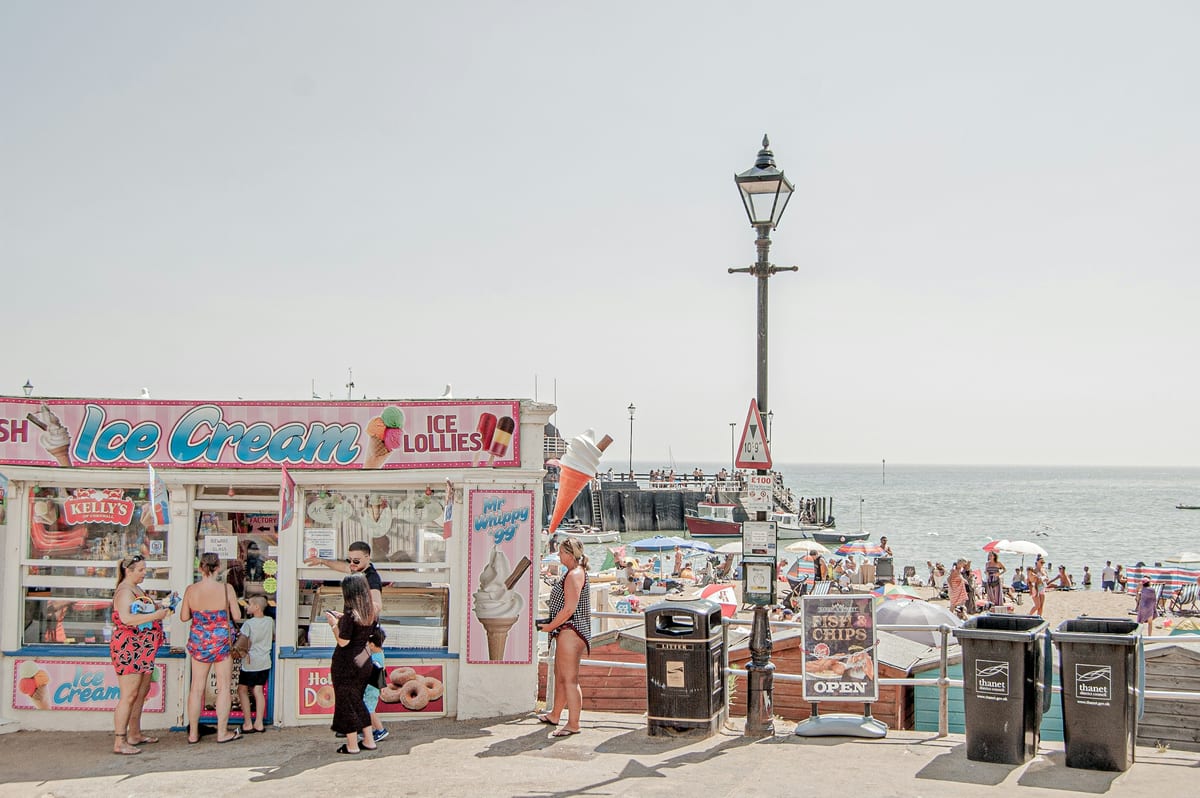
Small businesses can hedge business risk on prediction markets like Kalshi and Polymarket: regulated contracts that pay a fixed amount when an event that may negatively impact revenue or operations actually happens. A rained-out Saturday at a restaurant with a patio. A cold week that pushes customers away from an ice cream shop. A hometown playoff win at a bar that promised free food and drinks if the team won, and now has to pay for it.
The idea is not new. Utilities, farmers, and large companies have hedged weather, fuel, and crop prices for decades through futures and options desks; what a small business never had was a way in. Event contracts on regulated prediction market platforms changed that, and a handful of small businesses have started using them this way.
Why small businesses hedge, and why it used to be hard.
A hedge is a position that pays out when something goes wrong for the business, so a costly day gets softened instead of absorbed in full. It is not a bet on the business doing well; it is built to pay out when the specific event that would hurt it happens, offsetting a cost the business already carries rather than creating a new one.
Large institutions have hedged weather risk for decades. In July 1996, in what is generally described as the first weather derivative, Consolidated Edison bought its August power from Aquila Energy under a contract that paid the utility a rebate if the month ran cool, measured at the Central Park weather station.1Wikipedia, "Weather derivative," en.wikipedia.org, 2026 A cool August means less air conditioning and less electricity sold, so the rebate covered the sales the weather took away. Farmers lock in crop prices with futures for the same reason. The instruments differ; the logic is identical. Pay a known, smaller amount up front, like a premium, to cap a larger and uncertain loss later.
What kept small and family-owned businesses out was never the idea. It was the plumbing: those instruments clear through brokers and derivatives desks built for institutional volume, with account minimums and paperwork a small operator is not set up to carry.
Jim McIngvale, the Houston furniture retailer known as Mattress Mack, worked around that gap for years. He would promise customers a refund on their furniture if the Astros won the World Series, then place large bets on the Astros; when they won, the payout funded the refunds and the promotion had already driven the sales.2Forbes, "Mattress Mack Wins Record $75 Million Sports Betting Payout After Astros Win World Series," forbes.com, November 2022 The instinct was decades old, but the venue was a sportsbook, because nothing built for a business existed. What changed is access: regulated event contracts put the same move within reach of individuals and small businesses.
How a prediction market hedge works.
The simplest event contract is binary. It asks one yes-or-no question, trades between 1 and 99 cents, and settles at $1 if the event happens and $0 if it does not, so the most a buyer can lose is what they paid.3Kalshi, "Working with Event Contracts," news.kalshi.com, 2026 The price is the probability: a contract at 37 cents means the market gives that outcome roughly a 37 percent chance. Two details matter in practice. Weather and inflation contracts are usually sold as brackets, covering a range of outcomes where the buyer picks the band.4Kalshi, "Weather Markets," help.kalshi.com, July 2026 And a position can be sold before the event resolves, so a business that no longer needs its hedge can close it at the going price.5Polymarket, "Can I Sell Early?," help.polymarket.com, 2026
The Jeffrey, an Upper East Side bar owned by lawyer Andrew Freedman, shows the full arc. In May 2026 it ran a promotion taking 1 percent off every tab for each point of the Knicks' margin over the Cavaliers; the Knicks won by 37, so tabs were cut 37 percent and the night cost about $4,000.6MarketWatch, "NYC bar uses prediction markets to hedge against a new financial risk: A Knicks victory," marketwatch.com, June 2026 Bloomberg covered it, and Kalshi contacted the bar proposing it use the platform to cover the next one.
So for Game 1 of the 2026 NBA Finals against the Spurs, the hedge came first. The bar promised up to $100 off every tab if the Knicks won, a promotion Freedman estimated would cost around $13,000, and put $5,000 into contracts on a Knicks win priced at 37 cents, which bought roughly 13,500 contracts.7CNBC, "Kalshi wants small businesses to hedge like Wall Street. A NYC bar is trying it with Knicks promotion," cnbc.com, June 2026 Freedman put it plainly: “We're a small business; we can't just eat a full night's revenue on a whim.”8Kalshi, "NYC Local Bar The Jeffrey Uses Kalshi to Hedge Knicks Promotion," news.kalshi.com, June 2026
Both outcomes worked. A win pays those contracts $1 each, about $13,500, covering the free tabs; a loss costs the $5,000 and the bar keeps the revenue from a packed room. The Knicks won Game 1, 105-95, and the hedge paid the first time it fired.9ESPN, "Knicks 105-95 Spurs, Final Score," espn.com, June 2026 The position mirrored a real cost and was sized to it, which separates a hedge from a bet.
Get alerts on Economy markets. Set it up free in 30 seconds.
The business risks prediction markets can cover today.
Weather is the deepest category for a small business. Kalshi lists daily high and low temperature markets on major US cities, settling on official National Weather Service readings, structured as brackets: contracts covering temperature ranges plus “or above” and “or below” levels. Precipitation and snowfall markets run alongside them, and the same shelf carries longer seasonal contracts on hurricanes and severe weather. Daily weather markets have their own mechanics.
28wishes, an ice cream parlor in downtown Los Angeles run by brothers Jason and James Jiang, works that first category. The shop loses about 20 percent of business when the temperature drops below 70 degrees. Since April 2026 the brothers have put $20 a day into Kalshi weather contracts, using forecasts to buy the cold side of the Southern California temperature brackets before a front arrives.10New York Post, "Savvy ice cream shop owner makes 43% of monthly rent betting on weather," nypost.com, July 2026 When the cold day lands, those contracts settle at $1 each and the payout arrives on the day the shop is quiet. Winnings have reached $1,500 in a month against rent near $3,500, which at that scale is part hedge and part informed side income.
Seasonal contracts work on a longer clock. A coastal restaurant or motel carries a commercial hurricane deductible plus the days a storm forces it shut, and hurricane contracts are bought the way insurance is: in advance, before anyone knows how the season will go. Kalshi opens its Atlantic season contracts on April 1, two months before the season starts, and settles them in early December against the number of hurricanes the National Hurricane Center counted.11Kalshi, "Number of hurricanes" market series (KXHURCTOT), settled by the National Hurricane Center, kalshi.com, August 2026 A quiet season means the money spent on those contracts is gone. A bad season means they pay out, at the same time the business is absorbing the damage.
Coverage gets blunter from there: both platforms list national tornado counts settled by NOAA's Storm Prediction Center, and neither covers one county on one afternoon.12Kalshi, "Number of Tornadoes" market series (KXTORNADO), settled by the NOAA Storm Prediction Center, kalshi.com, August 2026
Beyond weather, the shelf covers economic releases a business feels directly: Federal Reserve rate decisions, inflation readings, and a gas price market settling on the AAA national average, which maps onto any business running vehicles.
Coverage is broader than big public events but narrower than a business's own numbers. Specific contracts do exist, including single-city weather stations, individual companies, and one named airport. NEXTPredict, a conference organizer, used that last one: a $12,000 premium for $3 million of coverage that pays if more than half the flights into JFK are canceled on its attendees' main travel day.13GlobeNewswire, "NEXTPredict Executes First-Ever Conference Hedge Through Kalshi," globenewswire.com, July 2026 That contract is restricted to around a thousand vetted institutional traders, so it previews where this is heading rather than what a small business can buy today.14Fortune, "Kalshi tiptoes back into canceled flight markets with JFK airport wager," fortune.com, July 2026
What a small business hedge could look like: two worked examples.
Start by quantifying what a bad day actually costs, in dollars rather than a general sense of slow business. Find a market whose settlement is directly tied to that bad day and to how the business operates, and check the contract's exact wording before buying, because settlement terms decide whether it pays when the business hurts. Then size the position to the dollar loss and no larger; sizing to the exposure keeps a hedge a hedge rather than a bet on the side. Treat the cost of being wrong as the premium paid for protection.
Take an outdoor-dining restaurant that loses about $1,500 on a rained-out Saturday night. If contracts on rain in its city that Saturday trade at 30 cents, about $640 buys roughly 2,100 of them. Rain means each settles at $1, returning about $2,100 against the lost night. Dry weather means they settle at zero and the $640 was the cost of the hedge.
A delivery bakery carries the slower version of the same exposure: a monthly fuel bill that runs about $500 higher whenever gas crosses $4 a gallon. If contracts on gas crossing that level trade at 40 cents, about $330 buys roughly 830 of them, returning about $830 if it crosses. If it stays under, the $330 is gone and the fuel bill landed where it was budgeted.
Both examples use invented prices to show the arithmetic. They are illustrations, not recommendations, and real prices, real liquidity, and trading fees have to be checked on the day.
The risks and limits small businesses should know before hedging.
1. A market may not exist for the risk you actually carry.
Contracts track public, measurable outcomes: a league game, an official temperature reading, an economic release. Nothing tracks foot traffic on one street, one supplier's schedule, or one venue's bookings.
2. The contract may not pay when the business hurts.
A contract settles on official data, such as a weather station reading or a national storm count, not on the business's own till. A month that felt disastrous inside the shop can miss the trigger entirely, while a hurricane hundreds of miles away pays in full. That gap is why settlement terms come before sizing.
3. Liquidity thins out fast away from the busiest markets.
The contracts a business most wants are often the ones almost nobody is trading. Hurricane markets get busy once a storm is named and heading somewhere, then go quiet for the rest of the year, so a business buying season coverage in the spring is shopping when few others are there. Kalshi lists a Texas deep-freeze contract, written after the 2021 grid failure, that has barely traded at all. When a market is that quiet, there may be nobody selling when the business wants to buy, the price can jump on a single order, and getting back out later is harder still.
4. Fees and price movement change the arithmetic.
Both exchanges charge a per-trade fee that is largest on contracts priced near 50 cents, so a hedge costs slightly more than the headline price.15Kalshi, "Fees," help.kalshi.com, 2026 Prices also move as the event approaches, which cuts both ways: a position can be closed early for whatever it is then worth.
5. Tax treatment is unsettled.
As of mid-2026 the IRS had issued no formal guidance on how event-contract gains are taxed, and practitioners disagree on the right approach.16Keeper, "How to File Taxes on Kalshi and Polymarket Earnings," keepertax.com, April 2026 That is a question for the accountant, not a settled cost.
6. Availability depends on the platform and the state.
The exchanges operate under federal regulation, but several states have challenged how certain contracts are offered, and which categories are available differs by platform and by state. Check current status before funding an account.